The Atlas of the Living Interstitium
The Atlas of the Living Interstitium is a growing field guide to the connective tissue of our movements and communities — the people, practices, and ideas that help resources, knowledge, and care flow to where they're needed most. Here you'll find tools and processes for interstitionary work, profiles of circulators and bridge-builders doing this work in the wild, a glossary for naming what often goes unnamed, and ongoing dispatches from the edges of sectors, disciplines, and networks. Think of it less as an archive and more as a space that’s alive in naming and framing the work that’s always been there, but that society hasn’t seen or valued.
Language for the in-between
A glossary in development …
Interstitium (physical)
The fluid-filled connective network discovered in the human body in 2018. It surrounds every organ, runs beneath the skin, and serves as a body-wide system for communication, nutrient transport, immune response, and shock absorption. Its structure is fractal and hexagonal.
Social interstitium (n.)
The connective layer of relationships, trust, and informal infrastructure that holds social systems together — the equivalent of the physical interstitium, operating between institutions, communities, and movements. When it's healthy, systems can sense, adapt, coordinate, and care. When it breaks down, systems fragment and become brittle.
Social immunocompetence (n.)
A community's capacity to use social relationships and collective behavior to sense threat, coordinate response, and support recovery — the way a healthy body's interstitium carries immune cells to wherever they're needed. When the social interstitium is strong, communities can absorb shock and heal. When it's damaged, systems become brittle and slow to respond. Via Ariel Brooks for Interstitia.
Interstitionary (n. and v.)
An interstitionary (noun) is a practitioner who works in the connective tissue between organizations, movements, and communities — weaving relationships, moving information, and enabling the flow of resources, trust, and meaning across otherwise fragmented systems. Interstitionaries tend the health of the whole, not just one institution or outcome. As a verb, people who aren’t wired to do this can also act as interstitionaries through connective actions they take.
Stitch (n., informal)
Short for interstitionary, it’s a term that also hearkens to the action that interstitionaries do – weaving together what’s been separating and creating coherence and a stronger social fabric.
Hexagon Person (n.)
A type of Interstitionary who moves fluidly between grounded, place-based work and broader cross-network weaving — stitching coherence across geography, identity, and sector. Like the hexagon itself, their presence is both efficient and load-bearing: the more that form and connect, the stronger the whole. Via Jennifer Brandel for Interstitia.
Circulation
One of the core practices of interstitionary work: moving between spaces (physically or virtually), absorbing and distributing insight, care, and connection. Circulators stitch trust across networks, reflect patterns back to communities, and help translate signals into action. We’re inspired by John Paul Lederach’s practices of circulation for conflict transformation.
Signal spotting
The practice of noticing subtle early indicators of how a living system is changing — listening for recurring tensions, new language, and the places where existing structures no longer fit the life they're meant to serve. Interstitionaries are often natural signal spotters: their position between institutions gives them early access to what isn't working, and what's quietly becoming something new. Via Hilary Van Welter for Coralus.
What’s missing?
More words will be added to this glossary as we learn what resonates and sticks with our community! If you have a nomination for a word or concept to add, reach out to us via the form at the bottom of the site.
What this looks like in practice
Interstitionaries show up everywhere. Here are some of the spaces we’ve spotted them in:
• The auntie who knows everyone's birthdays, favorite foods, and needs — the social glue of a family or neighborhood.
• The organizer who moves between funders, grassroots groups, and policy makers, translating each world to the others.
• The journalist who sees a gap between communities and builds infrastructure to bridge it — not as a story, but as a structure.
• The researcher who convenes across disciplines because the answer clearly doesn't live in any one field.
• The person who keeps leaving jobs because they keep outgrowing the org chart — their instinct is always toward the space between.
• The consultant who brings best practices from one client to another, working as a pollinator to spread good ideas across a field.
• The artist who translates practices and ideas from unimaginable to perceivable.
Check out profiles of interstitionaries below!
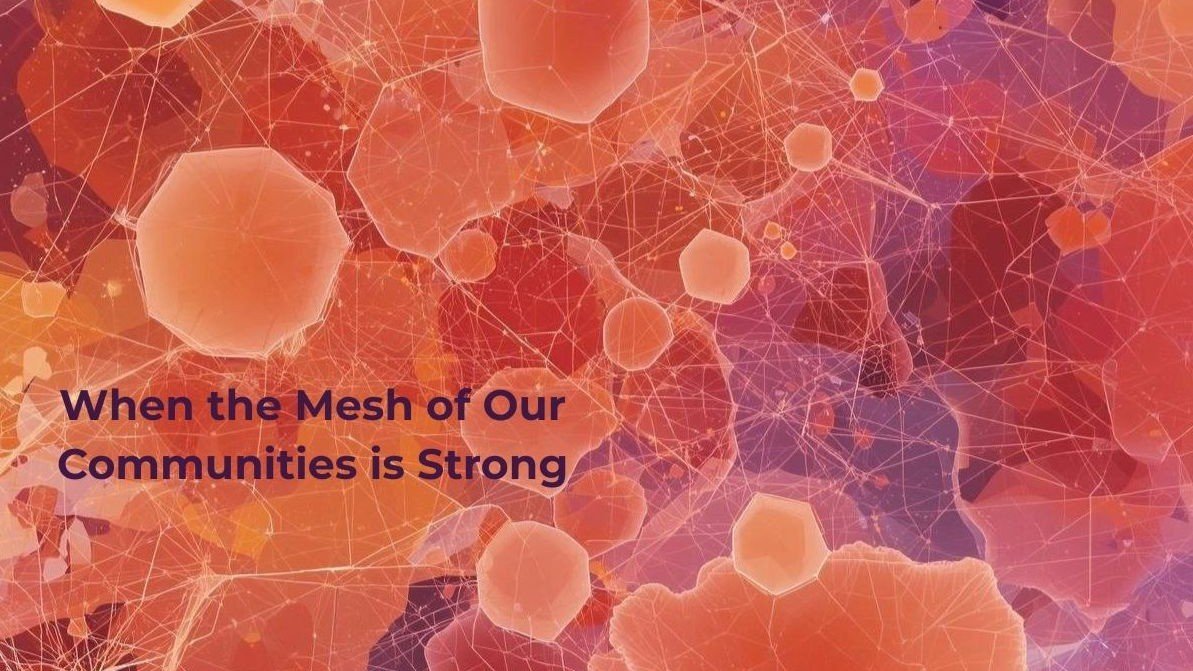
When the Mesh of Our Community Is Strong
When our interstitium is damaged, our capacity to heal (let alone flourish) is reduced. The same applies to the web of relationships that make up our social interstitium.
When the mesh of our communities are strong (family, friends, neighbors, colleagues, healers), our bodies and networks know what to do and all we need to prioritize is rest.